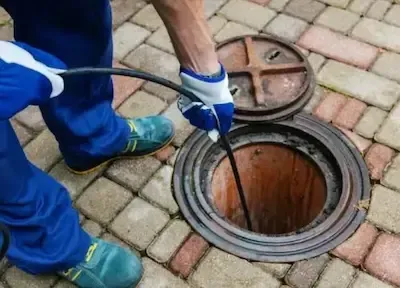
Clay Sewer Lateral Failure Patterns in Bexley OH Homes
Bexley's housing stock tells a story in pipe. Most of the homes lining Drexel Avenue, Fair Avenue, and the streets radiating off Bryden Road were built between the 1910s and 1950s, during an era when vitrified clay was the standard material for sewer laterals. That clay has now been underground for sixty to a hundred years, and the failure patterns plumbers encounter in these homes follow predictable progressions that every Bexley homeowner should understand before a backup turns into an excavation.
Why Clay Laterals Were Used and Why They Age Poorly
Vitrified clay pipe was the dominant lateral material through the mid-twentieth century for good reasons. It resists chemical corrosion, handles the biological environment of sewage well, and was locally available and cost-effective during Bexley's primary construction boom. The problem is not the clay itself but the joints. Pre-war laterals were assembled in short segments — typically three-foot sections — connected with bell-and-spigot joints packed with oakum and lead, or later with mortar. Those joints, spaced every three feet across a lateral that might run forty to seventy feet from the house to the Columbus sewer main, represent the system's primary vulnerability.
As decades pass, the surrounding soil settles. Tree roots grow. Ground shifts with freeze-thaw cycles. Each of those joint locations becomes a point where separation, offset, or root infiltration can begin. A lateral installed in 1935 has experienced roughly ninety winters in central Ohio soil. The wonder is not that they fail — it is that so many still function at all.
The Four Failure Patterns Bexley Plumbers See Most Often
When a plumber runs a camera through a clay lateral in an older Bexley neighborhood, they are typically looking for one of four conditions, often in combination:
- Root infiltration at joints: Fine root tendrils enter through separated or cracked joints and accumulate into masses that catch debris. This is the most common finding in homes near mature trees — a defining feature of Bexley's heavily canopied streets.
- Joint offset: Soil settlement causes pipe sections to shift out of alignment. Offsets create ledges where solids hang up and begin to build into blockages. Severe offsets create effective flow restrictions even without root involvement.
- Pipe sag or belly: When the soil beneath a pipe section settles unevenly, a low spot forms where wastewater pools rather than flows. Solids accumulate in the belly, and recurring clogs result even after the line is cleaned.
- Circumferential cracking and collapse: In the oldest laterals, full-pipe cracking — cracks running around the pipe circumference — can cause sections to collapse partially or fully. This is the terminal failure state and requires pipe replacement rather than cleaning or lining.
Understanding which of these conditions is present — and how many locations along the lateral are affected — determines whether a homeowner is dealing with a maintenance problem, a repair, or a full replacement project.
Why the Visible Damage Almost Never Represents the Full Scope
A common experience for Bexley homeowners is discovering that the plumber's camera found problems extending well beyond the single point that caused the backup. This is not upselling — it reflects a structural reality of aging clay systems. A lateral with one offset joint that triggered a blockage typically has additional compromised joints in adjacent sections. The failure that caused the backup was simply the weakest link. Addressing only that location leaves a system where the next failure is already developing two pipe-lengths away.
This pattern is one reason repair estimates on pre-war Bexley laterals frequently involve either spot-repair at multiple locations or a recommendation to line or replace the entire lateral. A licensed plumber doing thorough work will walk you through the camera footage and explain what each anomaly means rather than quoting a job based on the presenting symptom alone. If you want context for what a sewer emergency diagnosis typically involves, the the Bexley sewer emergency primer covers the sequence of steps from initial backup through scope of repair determination.
Tree Coverage and Root Pressure Specific to Bexley
Bexley's tree canopy is one of the city's defining characteristics, and the large oaks, maples, and elms lining residential streets like College Avenue and Montrose Avenue are often older than the houses they shade. Root systems from these trees extend well beyond the drip line and actively seek moisture — which means aging clay laterals with imperfect joints are prime targets. Willow, silver maple, and elm species are particularly aggressive in this respect.
Root pressure does not just infiltrate joints — it can cause gradual joint separation by physically moving pipe sections apart over years of growth. This is why root cutting as a standalone solution often proves temporary on Bexley laterals. Cutting the roots at the joint clears the blockage, but the joint remains compromised and accessible, and root regrowth is only a matter of time without a permanent repair to seal or replace the affected section.
What Camera Inspection Reveals That Snaking Cannot
A drain snake clears the obstruction that caused the backup. A camera inspection tells you what created the conditions for that obstruction and what is present elsewhere in the lateral. These are different scopes of information, and for clay laterals in an older Bexley neighborhood, the camera findings are often the more consequential result.
Specifically, camera inspection identifies joint condition at every segment along the run, reveals pipe belly locations that snaking will not correct, documents collapse zones that require excavation, and provides a baseline record of the lateral's current state. For a homeowner planning to stay in a Bexley home for years, that baseline has real value — it allows you to track whether conditions are stable or progressing.
Repair Options and Their Trade-offs
Once camera findings are documented, the practical options for aging clay laterals fall into a few categories:
- Spot excavation and repair: Targeted at a specific failure zone, this approach makes sense when camera findings show one or two isolated problem areas in an otherwise sound lateral. Cost is lower, but the lateral remains clay throughout.
- Cured-in-place pipe lining (CIPP): A resin-saturated liner is inserted and cured inside the existing pipe, creating a smooth interior surface that seals joints and resists roots. Effective when the existing pipe has sufficient structural integrity to support the process — collapsed sections typically require excavation first.
- Full lateral replacement: The clay lateral is excavated and replaced with PVC or another modern material. Most disruptive and expensive, but provides a definitive solution. Often the appropriate recommendation when camera findings show widespread joint separation, multiple offsets, or collapse zones.
For Sewer Backup Repair in Bexley, the right scope depends entirely on what the camera shows — not on the severity of the backup that brought the plumber to the door. A mild backup from a moderate root mass in a lateral with otherwise sound joints is a different situation than a recurring backup where camera footage shows offset joints at four locations over fifty feet of pipe.
What Bexley Homeowners Should Ask Before Any Lateral Work
If a plumber is recommending repair or replacement on a clay lateral, you are entitled to clear answers on the following: Was a full camera inspection completed, and can you see the footage? How many defect locations were identified along the entire lateral, not just at the blockage point? What is the pipe's structural condition — is CIPP viable or does collapse require excavation first? Will the repair address the Columbus city connection, or does the scope end at the property line? Answers to these questions let you evaluate the recommendation rather than simply accept or reject it.
Pre-war clay laterals in Bexley are not automatically failing systems — many are still functioning because the clay itself is durable. But functioning is not the same as sound, and the joint conditions in a ninety-year-old lateral rarely look like a system that has unlimited remaining life. Understanding the failure patterns that camera inspections reveal is the starting point for making repair decisions that reflect the actual condition of what is underground.
