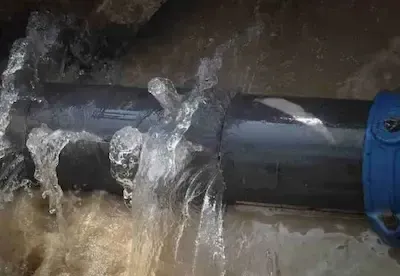
Galvanized Pipe Bursts in Bexley Pre-War Historic Homes
Bexley's tree-lined streets and brick colonials carry a quiet charm that newer suburbs simply cannot replicate. But inside those handsome walls, a different story unfolds for many homeowners: supply lines installed between the 1920s and early 1950s that have been quietly deteriorating for decades. Galvanized steel pipe was the standard of its era, and in pre-war construction throughout Bexley, it remains in service long past any reasonable lifespan. When those lines finally fail, the result is rarely a slow drip. It is a burst — sudden, pressurized, and capable of causing serious structural water damage within minutes.
Why Galvanized Pipe Fails Differently Than Other Materials
Galvanized pipe is steel coated in a thin layer of zinc. That zinc coating was designed to resist corrosion, and for a time it does exactly that. The problem is what happens next. As the zinc layer wears away — a process accelerated by the mineral content in central Ohio water — the steel underneath begins to oxidize from the inside out. The interior walls of the pipe narrow as rust accumulates, restricting flow and raising internal pressure at every fitting and joint.
This internal narrowing is invisible from the outside. A pipe can look structurally intact on the surface while its interior is choked down to a fraction of its original diameter. When that restricted pipe faces a pressure spike — a sudden demand surge, a water hammer event, or the thermal expansion that comes with a cold Ohio winter — the weakest point in the corroded wall gives way. Unlike copper or PEX failures that tend to present as pinhole leaks, galvanized failures often rupture across a wider section of pipe, releasing water at volume.
Where Burst Failures Cluster in Bexley Pre-War Floor Plans
The layout of older Bexley homes creates predictable failure zones. Most pre-war construction in the neighborhood routes supply lines through uninsulated or poorly insulated spaces: basement ceiling cavities, the wall chases behind original cast-iron radiators, and the crawl spaces beneath rear additions that were tacked on in the postwar years. These are the locations where galvanized pipe is most exposed to temperature swings and has received the least maintenance attention over the decades.
The main supply entry point — typically entering the basement from the southeast corner of the foundation on most Bexley lots along the Drexel Avenue and Cassady Avenue corridors — is another high-stress location. The pipe transitions from underground to interior conditions at this point, and the fitting connecting the municipal supply to the home's galvanized distribution network bears the full brunt of pressure from the street. When Columbus Water Works has flushed lines or adjusted pressure in the area, this fitting has been among the first casualties in older homes nearby.
Branch lines running to original bathrooms on the second floor are also vulnerable. These vertical runs pass through exterior wall cavities in homes where insulation was added after construction, meaning the insulation was packed around the pipe rather than installed with it in mind. The pipe is often in intermittent contact with cold masonry, and repeated freeze-thaw cycling over decades has worked micro-fractures into already corroded walls.
Recognizing the Warning Signs Before a Full Burst
Galvanized pipe rarely fails without giving some advance notice. The signals are easy to dismiss as minor inconveniences rather than structural warnings. Reduced water pressure at upper-floor fixtures is one of the most consistent early indicators - it reflects the narrowing interior diameter described above. Water that takes on a rusty or orange-brown color when you first run a tap, especially in the morning, suggests active interior corrosion scaling loose and entering the flow.
Visible exterior corrosion - white or rust-colored deposits forming around threaded joints - indicates that the pipe is already weeping moisture under pressure. This is not cosmetic. It means the threads have compromised integrity and the joint is on a timeline toward failure. If you own a pre-war Bexley home and see any of these signs, the appropriate response is not a wait-and-see approach. The question at that stage is not whether a burst will occur but where and when.
For a broader look at emergency response steps once a pipe has already failed, our Bexley burst pipe overview covers the immediate actions that limit damage while you wait for a plumber to arrive.
Spot Repair Versus Full Repipe: Making the Right Call
When a galvanized pipe bursts in a historic Bexley home, the first decision a homeowner faces is whether to repair the failed section or commit to a full repipe. The answer depends on a straightforward assessment: how much of the original galvanized supply network remains in place?
If the failed section is isolated - a single fitting at the main entry, for instance, with copper already replacing the rest of the distribution network - a targeted repair is defensible. But if the majority of your supply lines are still original galvanized, replacing only the burst section relocates the problem. Pressure that was failing at the burst point will redistribute to the next weakest section of corroded pipe. In most cases, that next failure follows within one to three years.
A full repipe to copper or PEX-A eliminates the underlying condition rather than its most recent symptom. For Bexley homeowners whose homes are in the historic district or are designated contributing structures, any repipe work should be coordinated with a contractor familiar with the City of Bexley's requirements around alterations to historic properties, since interior access points may involve walls or floors with architectural significance.
Burst Pipe Repair performed by a plumber experienced with older Bexley construction will include a full assessment of remaining galvanized runs before recommending whether a spot fix or system-wide replacement is the appropriate scope of work.
What Insurance and Documentation Look Like for Historic Homes
Pre-war homes in Bexley often carry homeowners insurance policies that were written before the galvanized pipe issue became a known underwriting concern. Some policies now exclude or limit coverage for damage caused by pipes that have exceeded a standard service life — typically defined around 50 years for galvanized steel. If your home was built in 1935 and still has original supply lines, those pipes are now approaching 90 years old. That is well outside any coverage window tied to service life exclusions.
Before a burst occurs, it is worth reviewing your policy language with your insurer specifically around pipe age and material. Documenting the current condition of your supply lines — through a plumber's written assessment and photographs — creates a baseline record that can support a claim if a failure does occur. For homes that have already completed a repipe, keeping that contractor's invoice and material documentation on file demonstrates that the known risk was addressed proactively.
A Realistic Picture for Bexley Homeowners
Owning a pre-war home in Bexley means accepting that infrastructure maintenance is part of the investment. The homes along Maryland Avenue, Bryden Road, and the streets adjacent to Bexley City Hall were built to last — but they were built with materials that have a finite service life. Galvanized supply pipe has exceeded that life in the majority of homes where it is still in use. Understanding where failure is most likely to originate, what the early warning signs look like, and when a full repipe outperforms a patch repair gives you the information to make decisions before a burst forces one on you.
